Saray Cumhuriyet Mahallesi Şehit Ali Aktaş Caddesi 23/D Pursaklar/Ankara
  +90 312 496 51 91
  info@aktifkonferans.com.tr


How Simultaneous Interpreting Systems Work?
At an international conference, while a speaker is giving a presentation in English, some attendees in the hall may listen in Turkish, some in German, and some in another language. The speaker continues their presentation without interruption, interpreters translate with a few seconds' delay, and attendees follow the event by choosing their own language channel. Behind this uninterrupted communication lies a well-planned simultaneous interpretation system.
Simultaneous interpretation is not simply about the interpreter translating what is spoken into another language. It requires the speaker's voice to be captured clearly, transmitted to the interpretation booth, the interpreter's translation transferred to a separate language channel, and this channel transmitted to the attendees' receiving devices. A problem at any point in this chain can result in the translation being incomprehensible or completely interrupted.
Therefore, the answer to the question "How do simultaneous interpretation systems work?" cannot be explained solely through headphones and microphones. The sound system, interpretation booth, interpreter console, transmitter infrastructure, language channels, receiving devices, technical control, and event operation must all be considered together.
The Path of Sound Within the System
The easiest way to understand the simultaneous interpretation system is to follow the path the speaker's voice takes until it reaches the participant. This process happens in a few seconds, but there are multiple technical stages in the background.
First, the speaker speaks through a podium microphone, lapel microphone, desk microphone, or wireless handheld microphone. The sound picked up by the microphone is transmitted to the event's main sound system. While participants hear the speaker's original voice through the speakers in the hall, the same sound is also sent to the interpretation booth.
The interpreter listens to the speaker through headphones inside the booth. They translate the speech into the target language in real-time and transmit the translation to the interpreter's microphone. The interpreter's voice is directed to the selected language channel.
Participants select the relevant language channel via their receiver device. They put on their headphones and listen to the translation performed by the interpreter. This entire process continues without interrupting the speaker's presentation.
The basic path of sound is as follows:
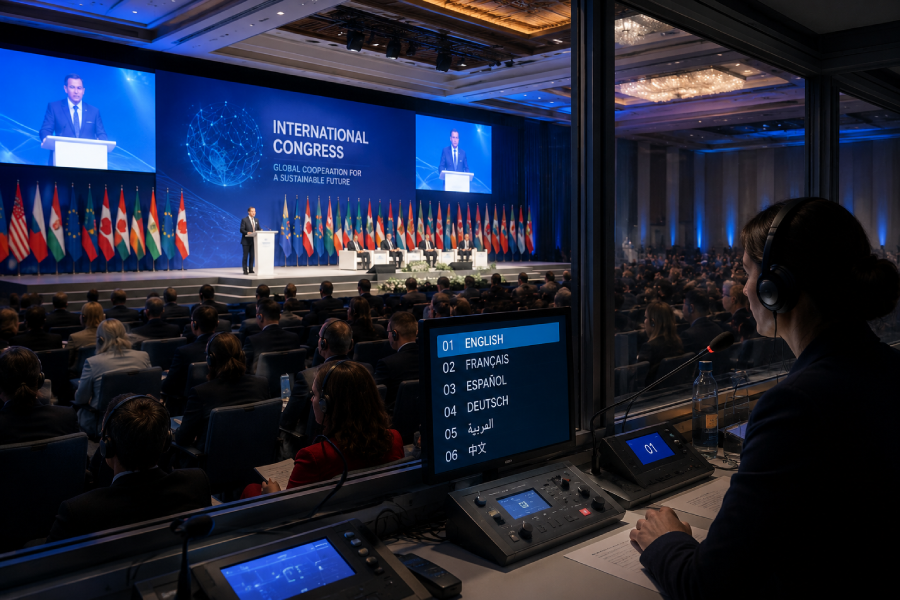
Speaker microphone → Main sound system → Translation booth → Interpreter console → Language channel → Transmitter system → Participant receiver → Headphones
For the system to function effectively, all these connections must be correctly established and tested before the event.
Why is Clear Speaker Voice Capture Important?
The quality of simultaneous interpretation is directly related to how clearly the interpreter can hear the speaker. Even if the interpreter is highly experienced, they may have difficulty providing accurate translation if the speaker's voice is muffled, low, or choppy.
Incorrect microphone positioning, ambient noise, high echo, or uncontrolled sound levels can affect the translation process. Participants speaking without microphones, especially in panel and question-and-answer sessions, can prevent the interpreter from hearing the questions.
Therefore, in events using simultaneous interpretation, all speeches should be delivered via microphone. The voices of the moderator, panelists, presenters, and participants asking questions should be transmitted to the main sound system in an organized manner.
The sound system and simultaneous interpretation infrastructure should be planned as an integrated system, not separately. The clearer the sound in the main hall, the higher the quality of the source material reaching the interpretation booth.
The Role of the Interpretation Booth in the System
The interpretation booth is the sound-controlled area where interpreters work. The primary purpose of the booth is to isolate interpreters from the noise in the hall and prevent their translation from interfering with the audience.
Since interpreters work with high concentration for hours, the location and internal conditions of the booth are crucial. The interpreter needs to be able to see the stage, the speaker, and the presentation screen. The speaker's gestures, presentation slides, and developments on stage help in understanding the context of the translation.
The booth is not just a soundproof box. Inside, there is an interpreter console, microphone, headphones, and language channel controls. In events using multiple languages, a separate booth or separate interpreter workspace can be planned for each language.
If the booth needs to be set up outside the hall or in a location where the speaker cannot be seen, camera and video monitor support should be provided. This allows interpreters to visually follow the stage flow.
How to Use the Interpreter Console?
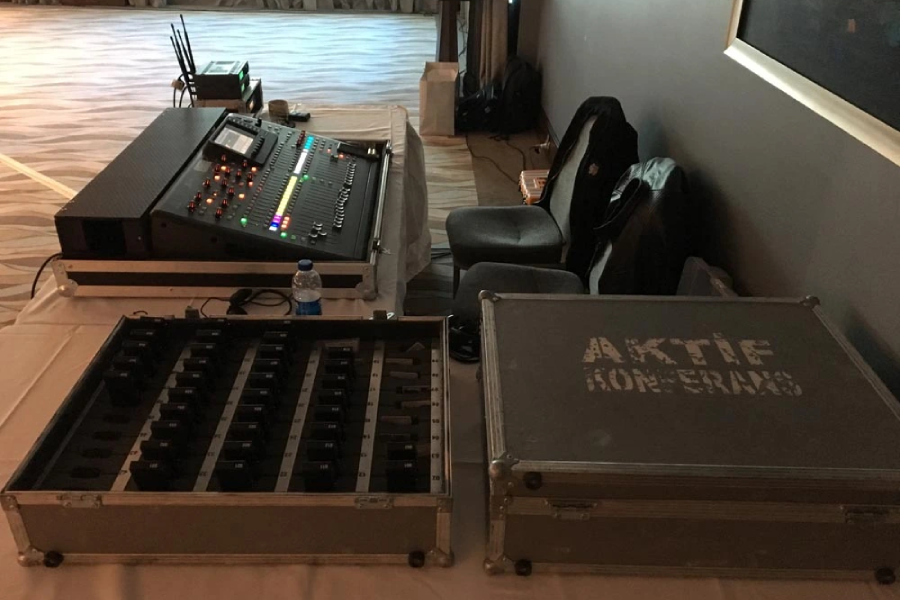
The interpreter console is the control center of the simultaneous interpretation process. The interpreter listens to the speaker's voice through this system, turns their microphone on and off, and manages the language channel they will be translating into.
Thanks to the headphone settings on the console, the interpreter can adjust the speaker's volume to their liking. When the microphone is turned on, the translated audio is sent to the designated language channel. Some systems may also include additional controls to facilitate task switching between interpreters.
In long-term conferences, interpreters usually work in shifts. While one interpreter translates, the other follows the terminology, checks presentation materials, or prepares for the next section. Correct microphone control is crucial during task switching. Accidentally leaving both microphones on or off at the same time can prevent participants from following the translation.
Therefore, the interpreters' familiarity with the system is as important as the technical specifications of the console itself.
How to Create Language Channels?
If an event has more than one target language, a separate channel is created for each language. For example, if the main speech is in English, the Turkish translation can be broadcast on the first channel, the German translation on the second channel, and the French translation on the third channel.
Participants select their language from the channel options on their receiving devices. This system allows different participants in the same hall to listen to translations in different languages simultaneously.
Language channels must be clearly planned before the event. The technical team, translators, and organizers must know which language will be broadcast on which channel. Participants should also be given channel information when they receive their devices.
Confusion in channel planning can cause congestion at the start of the event. For example, if a participant is directed to the wrong channel while waiting for the Turkish translation, they may think the system is not working. Therefore, channel numbers should be clearly indicated at the registration desk, at the hall entrance, or on the devices themselves.
How Does the Transmitter System Deliver the Translation to Participants?
The translation done by the translator does not go directly to the headphones. First, it is transferred to the transmitter infrastructure. The transmitter system sends the audio from the separate language channels to the receiving devices used by the participants.
Depending on the technical structure of the event, infrared or other wireless transmission solutions may be used. The system's coverage area should be planned according to the size and layout of the hall. Participants should be able to listen to the translation with the same quality at different points in the hall.
Incorrect positioning of transmitters or broadcasting units can cause signal attenuation in some areas. Columns, partitions, balconies, or large hall architecture can particularly affect coverage. Therefore, the hall structure should be evaluated during the technical assessment.
Before the event begins, technical personnel should check the signal by walking around different points in the hall with the receiver device. This way, blind spots or weak coverage areas can be identified in advance.
Participant Receivers and Headphones
Participants listen to the simultaneous translation via portable receiver devices and headphones. The receiver has channel selection and volume adjustment. Participants follow the translation by selecting the desired language channel.
The number of devices should be determined according to the number of people attending the event and using the translation. Having backup devices is also important. In case of battery problems, user error, or technical malfunction, backup equipment can be quickly activated.
In long conferences, headphone comfort affects the participant experience. Uncomfortable, low-quality headphones or headphones that don't work on one side make it difficult to follow the translation.
The device distribution and collection process should also be planned in advance. Sufficient staff should be assigned to prevent congestion at the registration desk, device handover should be recorded systematically, and collection points should be determined at the end of the event.
How to Manage Simultaneous Interpretation in Multiple Halls?
In large conferences, sessions may be held simultaneously in different halls. Each hall may have different speakers, different languages, and different participant groups. This makes the simultaneous interpretation infrastructure more comprehensive.
Each hall's microphone system, translation booth, language channels, and receiver device plan should be prepared separately. The translation channel in one hall should not interfere with another. The technical team must clearly track which system belongs to which hall.
The use of devices by participants changing halls between sessions should also be planned. In some organizations, devices are handed over at the hall entrance, while in others, participants may move to different halls with the same receiver. In this case, channel information and coverage structure should be adjusted accordingly.
In multi-hall conferences, central technical control, communication, and backup equipment planning are particularly important.
How to Conduct a Technical Rehearsal in a Simultaneous Interpreting System?
The system should not be turned on and used immediately on the day of the event. During the technical rehearsal, the entire signal chain, from microphones to receiver devices, should be tested.
First, it is checked whether the speaker microphones reach the interpretation booth. Interpreter consoles, microphones, and headphones are tested. It is verified that each language channel is routed to the correct output.
Then, tests are conducted in different areas of the hall with receiver devices. Sound level, signal quality, and channel switching are checked. Panel microphones, question-and-answer microphones, and video audio should also be included in the system.
If the speaker will be playing a video during the presentation, the video audio must also be transmitted to the interpreter. Otherwise, the interpreter will not be able to translate the video content.
The technical rehearsal is not only to understand whether the system is working, but also to ensure that all teams are familiar with the same flow. Interpreters, sound technicians, hall staff, and the organization team clarify their roles at this stage.
Common Errors That Disrupt System Operation
In simultaneous interpretation systems, problems often stem not from a single major malfunction, but from small planning deficiencies.
The speaker moving away from the microphone, panelists speaking to each other without microphones, or participants' questions being taken directly from the audience can cause the interpreter to miss the content.
Incorrect channel routing, receivers with low battery levels, insufficient number of devices, and the interpretation booth not being able to see the stage are also common problems.
Failure to share presentation and speaker materials with interpreters in advance can affect translation quality, especially in technical events. Terminology used in fields such as medicine, engineering, law, or finance needs to be prepared in advance.
Many of these problems can be prevented with pre-event coordination, technical rehearsals, and professional team support.
Simultaneous Interpretation System Setup with Aktif Conference
Aktif Conference offers simultaneous interpretation system solutions for international congresses, conferences, panels, corporate meetings, and multilingual events.
The number of languages spoken at the event, participant capacity, hall structure, and program flow are evaluated to plan the translation booths, consoles, transmitter systems, receivers, and headphones. Necessary connections are established with the microphone and main sound system to ensure the speaker's voice reaches the interpreters clearly.
After setup, language channels, devices, and hall coverage are tested. Throughout the event, the technical team monitors the system, provides support for device usage, and addresses any potential problems.
Planning the simultaneous interpretation system together with the audio, video, and congress technical infrastructure contributes to a more organized and uninterrupted event.
Seamless Language Flow from Speaker to Participant
Simultaneous interpretation systems not only translate the speaker's voice into another language but also bring together participants speaking different languages within the same event flow.
For this process to be successful, the entire technical chain, from the speaker's microphone to the translation booth, from language channels to participant receivers, must work harmoniously. High-quality equipment, accurate channel planning, appropriate booth placement, and technical control throughout the event are fundamental components of this structure.
With a properly established simultaneous translation system, the speaker can continue their presentation at their natural pace while participants follow the content in real time in their own languages. Thus, language differences cease to be a barrier limiting communication at congresses and conferences.