Saray Cumhuriyet Mahallesi Şehit Ali Aktaş Caddesi 23/D Pursaklar/Ankara
  +90 312 496 51 91
  info@aktifkonferans.com.tr


Simultaneous Interpreting at International Conferences
International congresses are important organizations where academics, industry representatives, experts, institutional managers, and participants from different countries share information in the same environment. Speakers may present in different languages at these events, and participants may wish to follow the presentations in their own languages. Therefore, simultaneous interpretation is a critical need for the efficient, understandable, and professional conduct of international congresses.
Simultaneous interpretation involves translating a speaker's speech into another language and transmitting it to participants via headphones. This method eliminates the need for the speaker to pause, prevents interruptions to the congress flow, and allows participants to listen to presentations in their own languages in real time. Simultaneous interpretation systems offer a significant advantage, especially in congresses with busy schedules where time management is crucial.
Successful communication at an international congress is not only possible with good interpreters. It also requires high-quality interpretation booths, receiving devices, headphones, microphone systems, transmitter infrastructure, and experienced technical team support. If this technical infrastructure is not properly established, the translation quality may decrease, participants may not be able to hear the speeches clearly, or communication disruptions may occur during the event.
Aktif Conference professionally supports the communication infrastructure of organizations with simultaneous interpretation systems, interpretation booths, receiving devices, headphones, and technical support services used in international congresses.
Why is Simultaneous Interpretation Important in International Congresses?
The most important goal in international congresses is to ensure that participants from different countries understand the same content correctly. The information conveyed in congresses often consists of academic, technical, sectoral, or scientific content. Therefore, misunderstandings of what is said can directly affect the effectiveness of the event.
A simultaneous interpretation system eliminates the language barrier, allowing all participants to follow the speeches in their own languages. When participants understand the content instantly, they can focus on the presentations more easily, participate more actively in the sessions, and communicate more effectively in question-and-answer sections.
The use of simultaneous interpretation in international congresses also strengthens the professional image of the organization. Providing a high-quality translation infrastructure in an event with participants from different languages shows that the congress is organized according to international standards. This is a reassuring effect for both organizers and participants.
How Does a Simultaneous Interpretation System Work?
Simultaneous interpretation works on the principle of transmitting the speaker's voice to the interpreter, the interpreter providing real-time translation, and this translation being conveyed to the participants. This process occurs with a delay of a few seconds, ensuring the smooth flow of the congress.
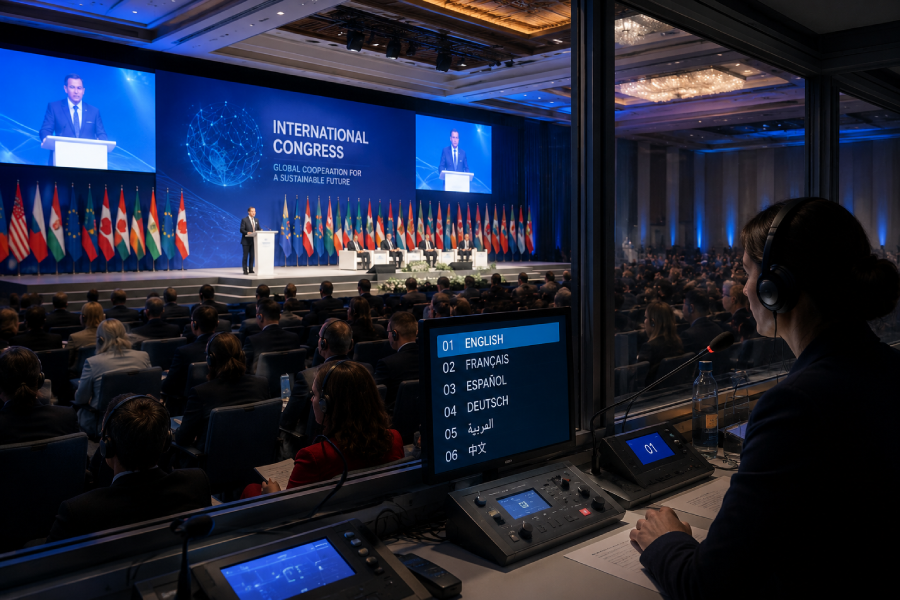
During the congress, the speaker speaks through a microphone. This sound is transmitted to the interpretation booth via the sound system. The interpreter listens to the speaker's voice through headphones and simultaneously translates into the target language. The translation is transmitted to the transmitter system via the interpreter's microphone. Participants listen to the translation using receiver devices and headphones provided to them.
If multiple languages are used in the congress, separate channels can be created for each language. For example, different language options such as Turkish, English, German, French, or Arabic can be offered to participants. Participants follow the speeches by selecting the appropriate channel in their language via their receiver device.
For this system to function smoothly, sound quality, channel management, interpretation booth layout, and the technical control process must be professionally planned.
Simultaneous Interpretation Equipment Used in International Congresses
Professional simultaneous interpretation service is provided by the harmonious operation of multiple pieces of equipment. The quality and proper setup of this equipment are crucial for the uninterrupted flow of translation throughout the congress.
Translation Booth
The translation booth is a dedicated area where translators listen to and translate the speech. Thanks to its soundproof structure, the translator can work without being affected by external noise. In international congresses, having translators in a location where they can see the stage, speakers, and presentation flow contributes to the quality of translation.
Receiver Devices
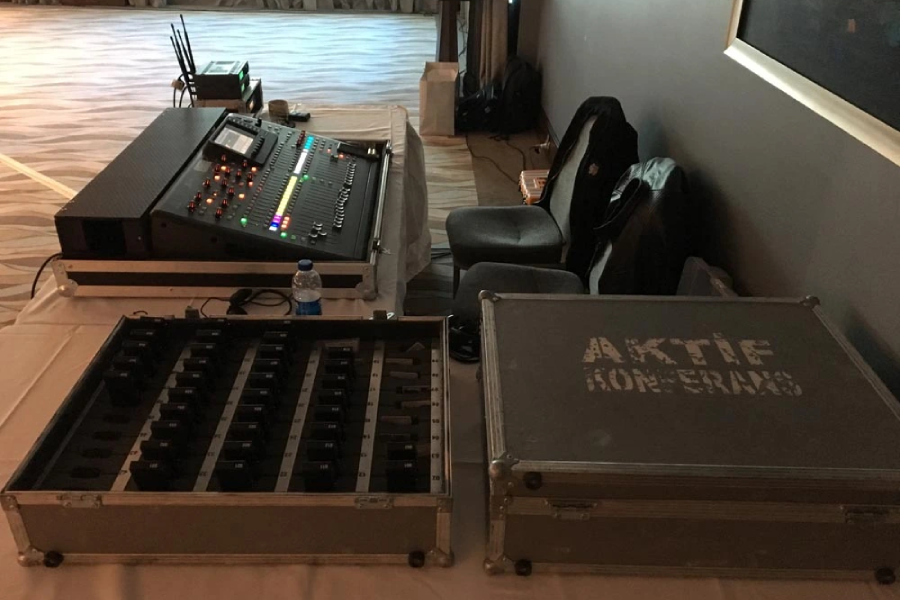
These are portable devices used by participants to listen to the translation. Each participant is given a receiver device. Language channel selection is possible on the device. Thus, participants can follow the congress by choosing the language that suits them.
Headphones
Headphones ensure that the translation audio reaches the participants clearly. In long congresses, the use of comfortable and high-quality headphones is important for the participant experience. Poor quality headphones can make it difficult to understand the translation.
Microphone Systems
Clearly capturing the speaker's voice is one of the fundamental requirements of simultaneous interpretation. The sound from the speaker's microphone must reach the interpreter clearly. When the sound quality is poor, the interpreter may have difficulty following the speech.
Transmitter and Channel Systems
This system transmits the interpreter's translation to the participants' receiving devices. A separate channel can be defined for each language. Correct channel management prevents participants from listening to the wrong language or experiencing sound confusion.
How Simultaneous Interpretation Strengthens the Flow of Congresses?
The program flow at international congresses is usually intense. Opening speeches, expert presentations, panel sessions, question-and-answer sections, presentations, and closing speeches proceed within a specific time schedule. To prevent disruption to this program, the translation process must be fast and uninterrupted.
In consecutive interpretation, the speaker pauses at certain intervals, and the interpreter is expected to translate. This method may be suitable for small meetings; however, it can significantly prolong the duration at large congresses. Simultaneous interpretation, on the other hand, reduces time loss because it advances the speech and translation simultaneously.
This structure helps participants follow the congress more fluently. While the speaker delivers their presentation at a natural pace, participants listen to the translation in their own languages. Thus, the event becomes a more professional experience for both speakers and listeners.
Which Congresses Use Simultaneous Interpretation?
Simultaneous interpretation systems can be used in all congresses with participants from different languages. This system is a fundamental necessity, especially in events with high international participation.
In academic congresses, researchers and academics from different countries may give presentations. The terminology used in such events often requires expertise. A professional simultaneous interpretation system should be used to ensure participants understand the content correctly.
Medical congresses are one of the most important areas of simultaneous interpretation use. Accurate translation of medical terms is crucial for the clarity of presentations and for participants to fully understand the scientific content.
Simultaneous interpretation systems are also frequently used in sectoral congresses. International congresses organized in the fields of industry, technology, energy, tourism, health, education, finance, and trade may have speakers from different countries. In these events, a professional translation infrastructure makes information sharing more efficient.
Simultaneous Interpretation in Panel and Q&A Sessions
Panel and Q&A sessions at international congresses are crucial areas requiring careful planning of simultaneous interpretation systems. This is because multiple speakers, moderators, and participants are involved in the same flow.
In panel sessions, each speaker's microphone sound must be clearly transmitted to the interpreter. The moderator's questions, the panelists' answers, and participant comments must be accurately conveyed through the system. If microphone usage is irregular, the interpreter may not be able to hear the speeches clearly, and the translation quality may decrease.
In Q&A sessions, participant microphones must also be integrated into the system. Questions from participants must be transmitted to the interpreter, who must then translate them into the target language. Therefore, the sound system and the simultaneous interpretation system should be planned together in panel and Q&A sessions.
Technical Planning in Simultaneous Interpretation Systems
Technical planning is essential for the successful operation of simultaneous interpretation systems at international congresses. First, the number of languages to be used at the congress must be determined. Separate interpreters, separate channels, and appropriate technical arrangements may be required for each language.
The number of participants is also a significant factor in planning. The number of people who will be provided with receivers and headphones should be determined in advance. Insufficient equipment planning can negatively impact participant satisfaction during the congress.
The location of the interpreting booth should also be carefully determined. Having interpreters work in a location where they can see the stage, speakers, and presentation screen improves translation quality. Furthermore, the booth's connection to the sound system and channel infrastructure should be tested before the event.
A technical rehearsal must be conducted before the event begins. Microphones, the interpreting booth, receivers, headphones, language channels, and sound levels should be checked. These tests can help prevent technical problems that may arise during the congress.
Why is Professional Technical Support Necessary?
Simultaneous interpretation systems are technically sensitive. A small sound interruption, channel mix-up, or receiver device problem during a congress can make it difficult for participants to follow the speeches. Therefore, professional technical support should be available throughout the event.
The technical team sets up the system, tests the devices, supports the distribution of participant devices, and monitors the system throughout the congress. They prevent disruption to the event flow by quickly intervening in case of a problem.
In international congresses, technical support doesn't just mean checking the devices. It also includes constantly monitoring the harmony between speaker microphones, the sound system, the translation booth, receiver devices, and channel management. Therefore, experienced technical team support is an integral part of simultaneous interpretation services.
Simultaneous Interpretation Services at International Congresses with Aktif Conference
Strong communication at international congresses directly affects the success of the event. For participants from different languages to accurately follow the same content, simultaneous interpretation systems need to be professionally set up.
Aktif Conference offers professional solutions for simultaneous interpretation systems needed at international congresses. Translation booths, receiving devices, headphones, microphone systems, transmitter infrastructure, and technical control processes are planned according to the needs of the congress.
From setup to technical testing, from equipment distribution to operational support throughout the event, the entire process is managed by an experienced team. This allows participants to follow the speeches seamlessly in their native languages, resulting in a more efficient communication structure for the congress.
The Right Translation Infrastructure for Strong Communication at International Congresses
Successful communication at international congresses depends not only on the speakers' knowledge but also on the accurate dissemination of this knowledge to all participants. Simultaneous interpretation systems enable participants from different languages to follow the same content in real time, helping congresses proceed more professionally and efficiently.
A well-planned simultaneous interpretation infrastructure does not interrupt the flow of the event, facilitates time management, and enhances the participant experience. Systems established with quality equipment, experienced translators, and professional technical support significantly improve the communication quality of international congresses.
Therefore, simultaneous interpretation services should be considered one of the fundamental technical needs of congresses with international participants.